
What Does AuDHD Mean? ADHD and Autism Explained
What is AuDHD?
AuDHD is a term embraced within neurodivergent communities to describe autistic and ADHD individuals whose lived experiences reflect both neurotypes. An AuDHDer is both autistic and ADHD, identifying through either self-diagnosis or formal diagnosis.
Although autism and ADHD are defined separately in the Diagnostic and Statistical Manual of Mental Disorders, emerging clinical and neurodiversity informed perspectives view AuDHD as far more than a residual category. Many autistic and ADHD individuals share overlapping traits, including sensory sensitivities, executive functioning differences, and emotional intensity. These characteristics interact dynamically in daily life rather than existing as isolated or distinct conditions. Approximately 50 to 70% percent of autistic individuals also meet criteria for ADHD, and 30 to 80% of ADHDers also meet criteria for Autism (Craddock, 2024; Hours et al., 2022). This significant rate of co-occurrence demonstrates that AuDHD is not a rare overlap, but a common neurotype that warrants recognition, validation, and deeper understanding.
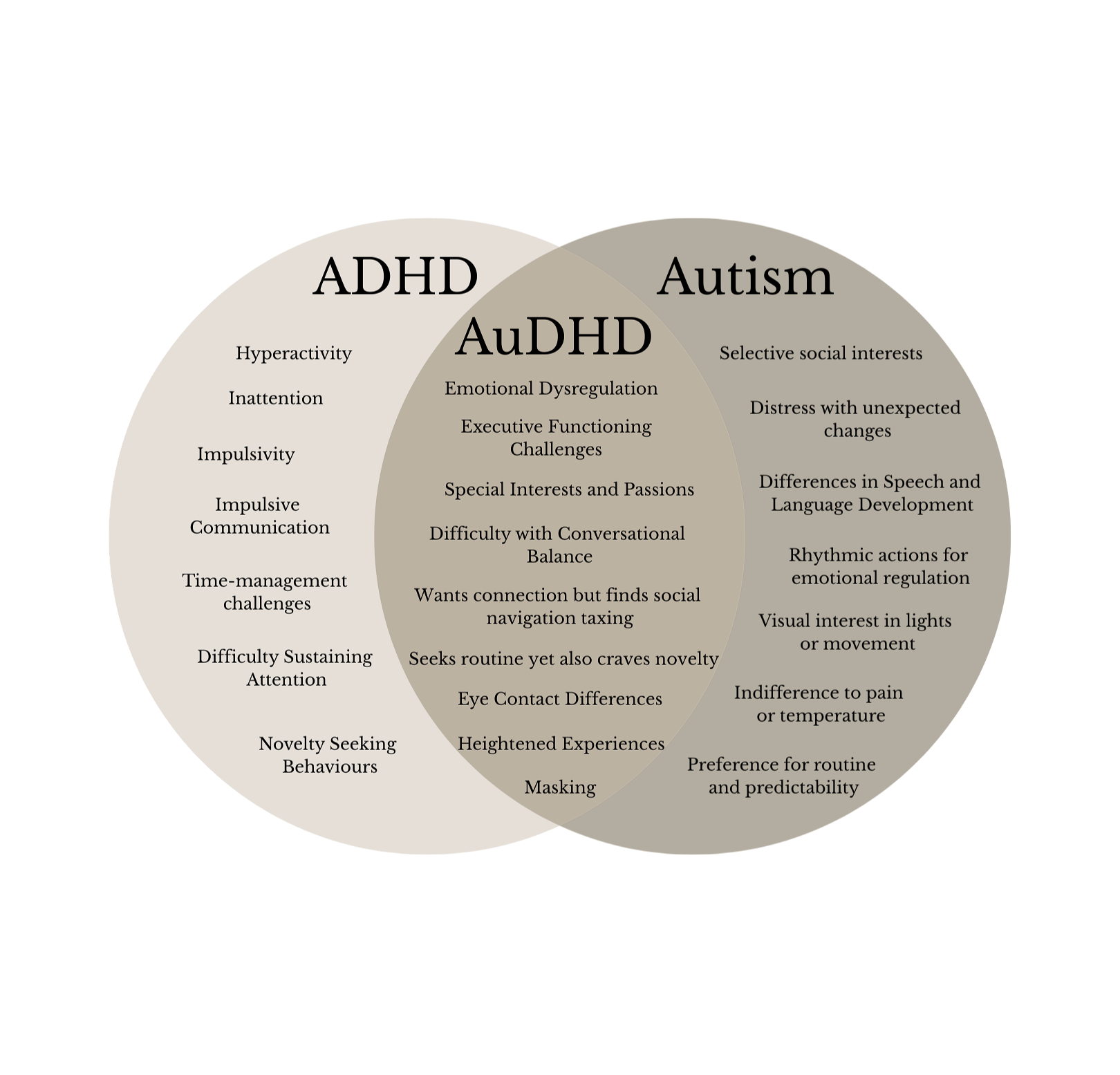
Figure: Venn diagram showing overlapping and distinct traits in ADHD and Autism, commonly seen in AuDHD (co-occurring Autism and ADHD). Created by Neurodiversity Wellness Collective.
How AuDHD Can Feel Internally
Living with both Autism and ADHD does not feel like having two separate labels. It often feels like moving through the world with a brain that sends mixed signals, with conflicting needs, all happening at once.
These are not personal failings. They are valid expressions of a nervous system that processes, feels, and responds differently.
Here are some common internal experiences shared by people with AuDHD:
1. You want connection but need space
You may feel a strong need to connect with others but quickly become overwhelmed by the sensory or emotional intensity of social situations. This can lead to withdrawing just moments after reaching out.
2. You crave structure but struggle to maintain it
You might feel best with clear routines, yet still find it difficult to start tasks or follow through.
3. You feel deeply but cannot always explain it
You may have strong emotional reactions, but naming or expressing those emotions can be difficult. This can feel confusing to others and isolating for you.
4. You switch between intense focus and total shutdown
You might hyperfocus for hours on something meaningful or interesting, then suddenly lose all energy.
5. You mask to cope, but it drains you
You may work hard to appear fine or functional on the outside, while feeling overwhelmed and overstimulated inside. Masking to meet society’s and other people’s expectations can be deeply exhausting.
Common Concerns AuDHD Adults Seek Support For
AuDHD adults often reach out for help with:
Chronic burnout from years of masking
Sensory overload and sensory fatigue
Emotional intensity, shutdowns, or difficulty recovering from distress
Rejection sensitivity
Executive functioning differences (time blindness, disorganization, task initiation challenges)
Identity exploration during or after a late discovery of neurodivergence
Relationship communication, boundaries, and social exhaustion
Building sustainable routines that honour sensory and cognitive needs
Healing from past invalidation, stigma, or misdiagnosis
References
Craddock, E. (2024). Raising the voices of AuDHD women and girls: Exploring the co-occurring conditions of autism and ADHD. Disability & Society, 39(8), 2161–2165. https://doi.org/10.1080/09687599.2023.2299342
Hours, C., Recasens, C., & Baleyte, J. M. (2022). ASD and ADHD comorbidity: What are we talking about?. Frontiers in Psychiatry, 13, Article e837424. https://doi.org/10.3389/fpsyt.2022.837424
Huang, Z., Wang, F., Xue, L., Zhu, H., & Zou, X. (2024). Relationships between sensory processing and executive functions in children with combined ASD and ADHD compared to typically developing and single disorder groups. Brain Sciences, 14(6), 566. https://doi.org/10.3390/brainsci14060566
Liu, C. A., Townes, P., Panesar, P., & Lee, S. Y. (2024). Executive function in ADHD and ASD: A scoping review. Review Journal of Autism and Developmental Disorders, 12(1). https://doi.org/10.1007/s40489-024-00444-3
