
Autistic Special Interests vs. ADHD Hyperfixation: What's Actually Different
Many neurodivergent adults experience a profound intensity when throwing themselves into a passion, whether they call it a special interest or a hyperfixation. Although often used interchangeably, distinguishing between the two matters because understanding your brain chemistry helps you navigate these experiences and support yourself. This article explores the neurological and experiential differences between autistic special interests and ADHD hyperfixations while examining how they overlap in AuDHD adults.
What Are Autistic Special Interests?
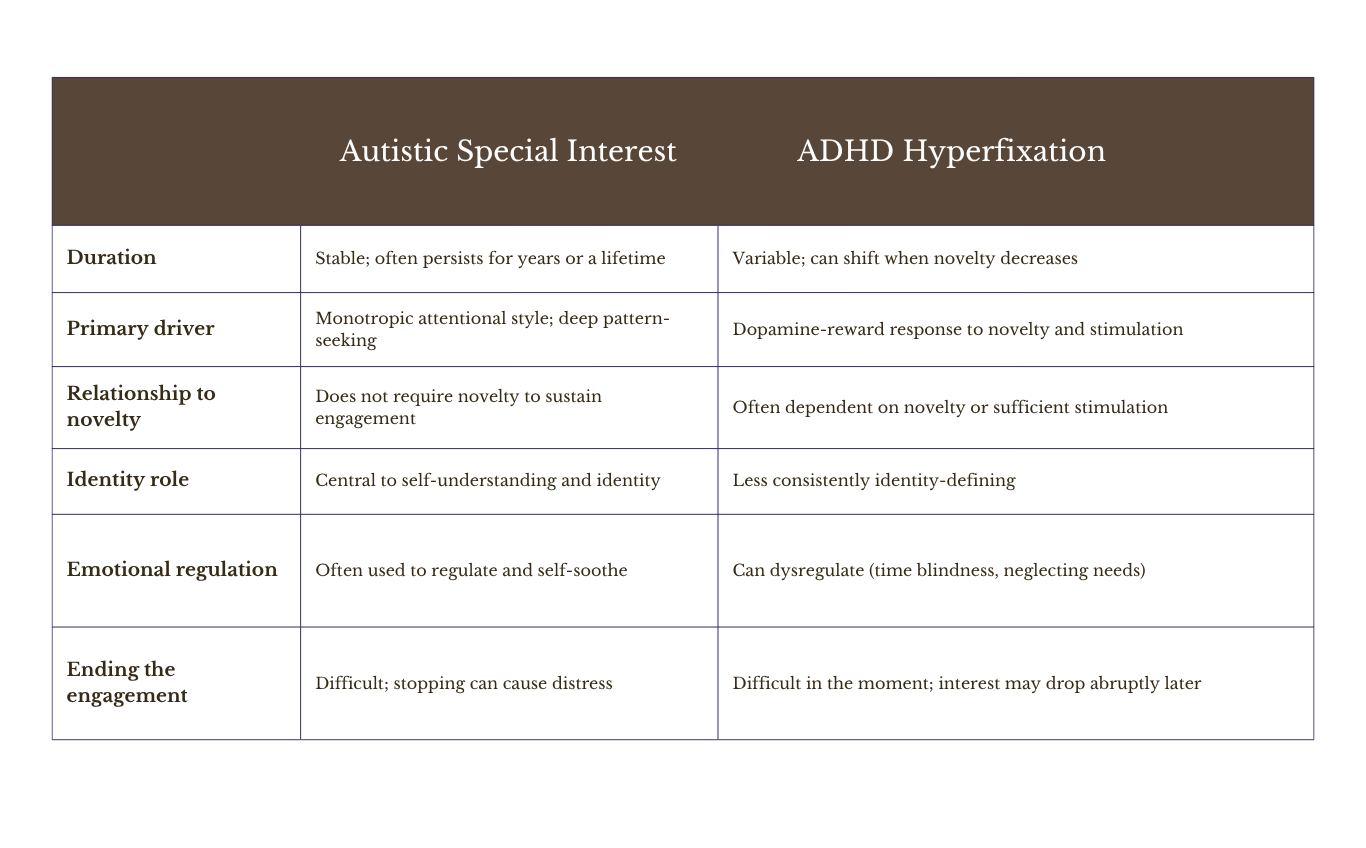
Autistic special interests (sometimes called SPINs), appear in diagnostic manuals like the DSM 5 and ICD 11 under repetitive behaviours, yet this clinical framing understates how they can actually serve as sources of joy, identity, competence, and emotional regulation. Unlike a typical hobby, a special interest is a highly stable, intense fascination that persists over years or a lifetime because its pull does not depend on novelty to hold your attention.
Special Interests and Identity
For many autistic adults, a special interest is a way to understand themselves, build community, and discover meaning in a challenging world. While clinical frameworks often mistake intense focus for social withdrawal, research shows that these passions are actually a pathway for autistic people to form genuine connections (Long, 2025). Crucially, the impact depends on the individual relationship to the interest, as those who engage out of genuine intrinsic motivation rather than compulsion experience much higher wellbeing and social satisfaction (Grove et al., 2018).
The Role of Monotropism
Special interests are intertwined with monotropism, which is the autistic cognitive tendency to focus attention intensely on a narrow range of subjects. Monotropism theory views this intense focus as a natural brain style instead of a flaw, allowing you to build incredible expertise at the expense of easy task switching and making special interests the perfect expression of how your mind naturally learns (Dwyer et al., 2024).
What Is ADHD Hyperfixation?
Hyperfixation, sometimes called hyperfocus, is an intense state of concentration driven by the ADHD dopamine reward system that locks onto shiny new obsessions, rabbit holes, or novel activities while completely blocking out time, hunger, fatigue, and responsibilities. Although not listed in official DSM 5 diagnostic criteria, this widely recognized experience is the flip side of executive dysfunction, explaining why a brain that struggles to start routine tasks can lock so deeply onto something exciting.
Dopamine and the ADHD Reward System
Neurological research confirms that while a low dopamine baseline makes daily chores feel completely unrewarding, chasing a shiny new side quest triggers a massive chemical hit that locks your focus in place for hours without you even trying (MacDonald et al., 2024). This chemical difference explains why you might struggle to start a simple fifteen minute task yet easily spend six hours deep diving into a random topic, proving that the struggle is about brain chemistry instead of willpower.
Hyperfixation Is Interest-Driven, But the Interest May Not Last
ADHD hyperfixation is completely hooked on novelty. Because your brain craves anything new and exciting, it can abruptly check out the second that shiny new feeling wears off, even if nothing about the hobby itself has changed. You might spend weeks completely obsessed with a new side quest, only to wake up one day and find the spark is just totally gone.
How They Differ: A Side-by-Side
The AuDHD Experience: When Both Are Present
For AuDHD adults, autistic monotropism and ADHD dopamine-seeking overlap, creating a focus that pulls from both systems at the exact same time. Although research on the combined AuDHD profile is still early, Dwyer et al. (2024) found that hyperfocus is high in both autism and ADHD and linked to inattention, suggesting they are different expressions of the same atypical attention system.
What This Means for Wellbeing
The Benefits
Research shows that special interests boost overall life satisfaction, connection, and meaning for autistic adults (Grove et al., 2018; Long, 2025). In fact, having a positive autistic identity, which these interests help shape, acts as a shield for your mental health, lowering anxiety and depression (Davies et al., 2024).
The Costs
If a special interest becomes too consuming, it can crowd out other parts of life and hurt your wellbeing (Grove et al., 2018). ADHD hyperfixations also come with time blindness, forgetting to eat or sleep, struggling to pull yourself away, and a mental crash when the interest suddenly fades. For AuDHDers, constantly managing both of these forces at the same time is exhausting.
A Neurodiversity-Affirming Approach to Intense Interests
Instead of trying to reduce special interests or hyperfixations, a neurodiversity-affirming approach views them as valuable clues about how your brain regulates itself.
In Therapy
In therapy, this looks like figuring out what these interests actually provide, whether that is emotional regulation, identity, or connection, and helping you access those benefits, rather than trying to dial down the intensity. For ADHD hyperfixation, it means working with your dopamine system's natural highs and lows, rather than trying to force a standard focus style that doesn't work for you.
It also means holding space for the grief that can come with these traits, including the childhood shame of being mocked for your interests, the relationships strained by hyperfocus and time blindness.
References
Davies, J., Cooper, K., Killick, E., Sam, E., Healy, M., Thompson, G., Mandy, W., & Crane, L. (2024). Autistic identity: A systematic review of quantitative research. Autism Research, 17(5), 874–897. https://doi.org/10.1002/aur.3105
Dwyer, P., Williams, Z. J., Lawson, W. B., & Rivera, S. M. (2024). A trans-diagnostic investigation of attention, hyper-focus, and monotropism in autism, attention dysregulation hyperactivity development, and the general population. Neurodiversity, 2. https://doi.org/10.1177/27546330241237883
Grove, R., Hoekstra, R. A., Wierda, M., & Begeer, S. (2018). Special interests and subjective wellbeing in autistic adults. Autism Research, 11(5), 766–775. https://doi.org/10.1002/aur.1931
Long, R.-E. M. (2025). Access points: Understanding special interests through autistic narratives. Autism in Adulthood, 7(1), 100–111. https://doi.org/10.1089/aut.2023.0157
MacDonald, H. J., Kleppe, R., Szigetvari, P. D., & Haavik, J. (2024). The dopamine hypothesis for ADHD: An evaluation of evidence accumulated from human studies and animal models. Frontiers in Psychiatry, 15, Article e1492126. https://doi.org/10.3389/fpsyt.2024.1492126