Clinical Supervision vs Clinical Consultation: What's the Difference?
These two terms get used interchangeably, but they are not the same thing. Understanding the distinction matters for counsellors and allied professionals, both for your professional development and for your ethical and legal responsibility.
The Short Answer
Clinical supervision is a formal, evaluative relationship in which a more experienced registered clinician oversees the work of a student or provisionally registered therapist. The supervisor holds accountability, ethically and legally, for the supervisee's client work. Supervision is typically required for registration and licensure, and in BC, it is increasingly governed by specific regulatory requirements as psychotherapy moves toward regulation under the Health Professions Act.
Clinical consultation is a voluntary, collegial exchange between registered professionals where the consultant provides perspective while the consultee retains full responsibility for their own clinical decisions.
How They Differ in Practice
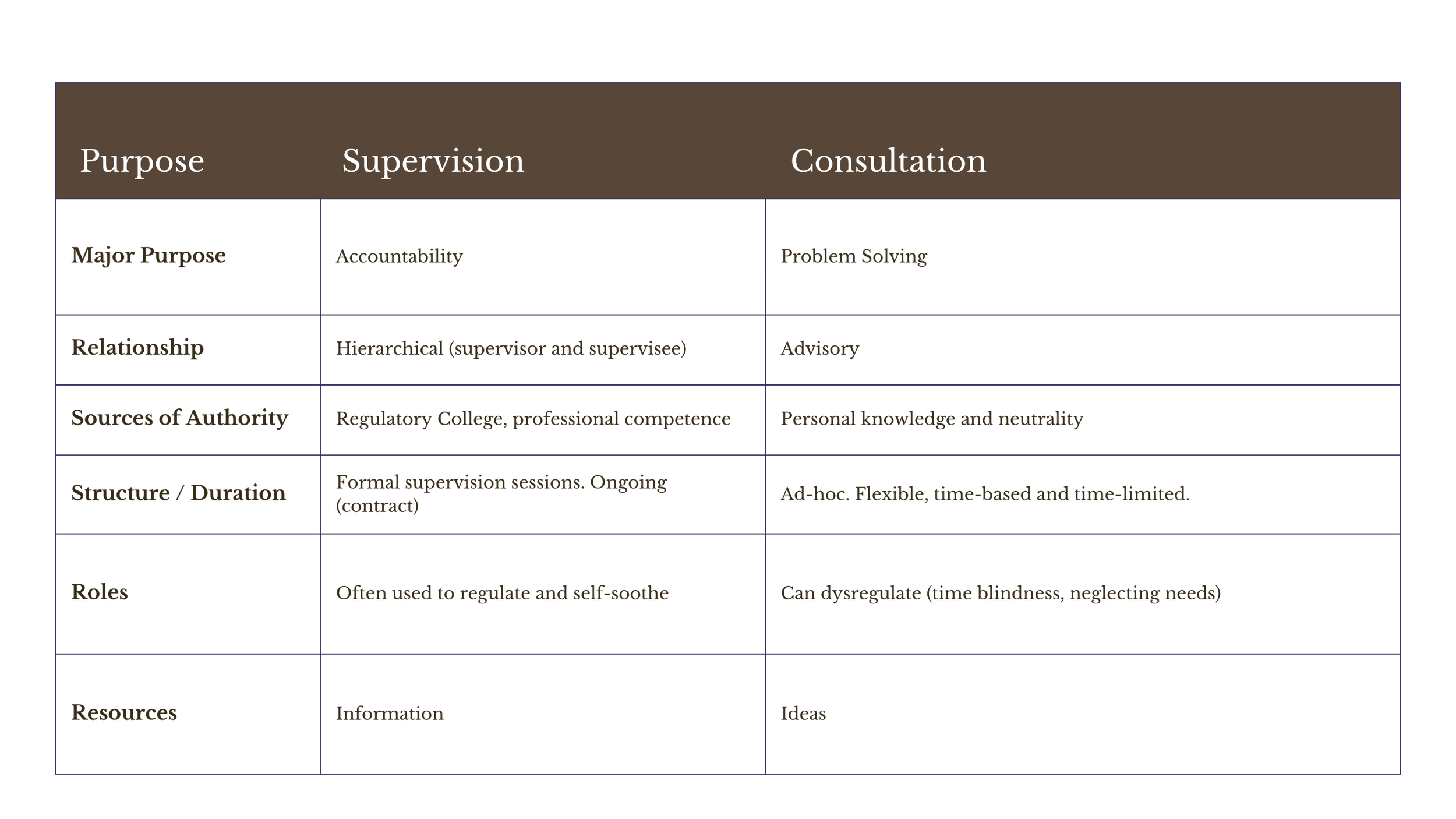
Important: Because requirements can vary depending on your designation and governing body (such as the BCACC, CCPA, or the CRPO, always check with your own regulatory body to confirm what specific activities and hours qualify.
Why This Matters for Neurodivergent Affirming Practice
For practitioners working with neurodivergent clients, neurodivergent-affirming consultation offers a collaborative space, a conversation with someone who brings both clinical knowledge and lived experience of the topic you are working through, where a consultant sits alongside you to share these insights, helping you develop an affirming framework, work through complex cases, and access specialized knowledge missing from traditional training, empowering you to decide what best fits your practice.
What Neurodivergent Affirming Consultation Looks Like
Most clinical training programs do not adequately prepare therapists to work with neurodivergent adults. Approaches taught as gold standard, can inadvertently cause iatrogenic harm to neurodivergent clients. Consultation can be a space to examine those gaps directly. That might look like discussing how to adapt therapy modalities for a specific client, exploring how masking and burnout are presenting in someone's case, or thinking through the cultural and identity dimensions of neurodivergence in a client from a BIPOC or immigrant background.
If you are wanting to deepen your knowledge and practice, our counsellor, Yuka, who is an AuDHD Registered Clinical Counsellor, offers neurodivergent affirming clinical consultation grounded in an intersectional lens and lived experience to support your professional growth.