A Lived Experience of Level 1 Autism as an Adult
Spending your life working twice as hard as everyone else just to appear normal creates an invisible exhaustion. You never stand out, but you also never struggle visibly enough to receive help. Instead, you constantly expend double the energy just to achieve standard results, wondering why daily life never gets easier.
That hidden strain is what Level 1 autism in adults looks like from the inside. From the outside, it looks like nothing at all.
I am a late-diagnosed autistic person with Level 1 autism who also has ADHD, AuDHD, in the shorthand that finally has a name. This level of autism is one that goes unrecognized and is rarely what society expects. It is often the person sitting across from you at work or studying longer than anyone in the library. This article is about that version, what it actually looks like, what the research says about it, and what it costs to go through life without a framework for it.
What Level 1 autism actually means
The DSM-5 categorizes autism spectrum disorder into three levels based on required daily support. Level 1, defined as "requiring support," covers individuals with noticeable social communication differences and restricted or repetitive behaviours who do not need intensive, constant assistance. It largely replaces Asperger's syndrome, a formal diagnosis that no longer exists but one many adults still identify with. The label doesn’t mean a person's internal experience is mild or their difficulties are minor. It describes how visible their needs are from the outside, not how significant they are from the inside.
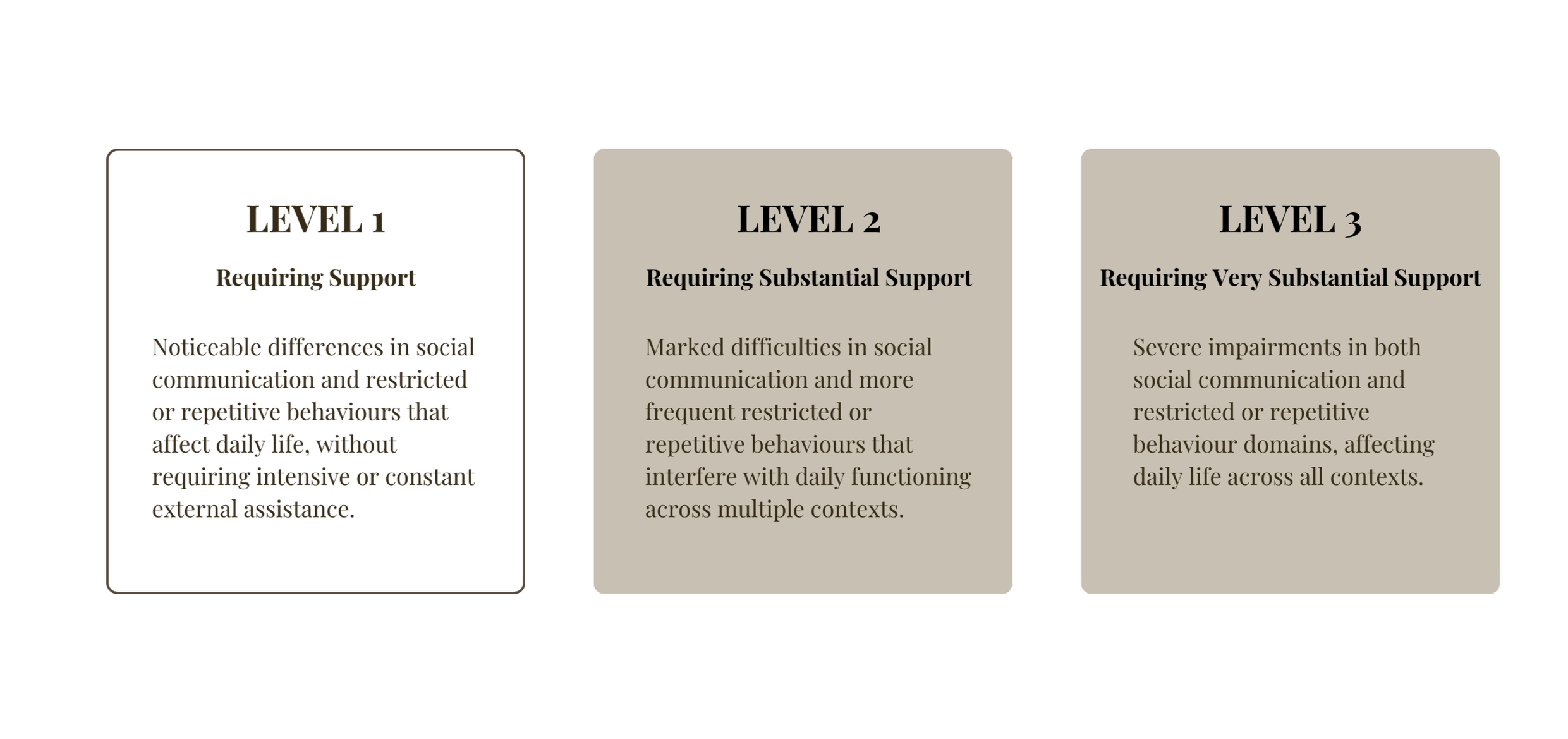
Support levels are not fixed. The same person can need significantly more support in unfamiliar, high-demand, or high-stress environments than they do in structured and familiar ones.
What Level 1 Autism Actually Feels Like (in Social Situations) and How Masking Makes It Invisible
In social interactions with acquaintances, strangers, or networking events where masking feels necessary, this used to be my lived experience with Level 1 autism, where each interaction demanded intense pre-anxiety, mental scripting, and so much energy just to get through it.
On top of tracking what to say and figuring out how to respond when the topic is unfamiliar or uninteresting, I used to engage in a lot of masking behaviours such as forcing eye contact, suppressing the urge to fidget or touch my fingers, stopping my cricket feet, mirroring the people around me, scripting responses in advance, and hiding sensory pain like the texture of my clothing feeling uncomfortable and itchy. All of this happened while the lights were too bright, the room was too loud, the background noise and chewing and music were all arriving at once, and my clothes felt wrong in a way that could not be fixed right now because fixing it would mean my mind thinking about how people would perceive me. While neurotypical people handle these interactions automatically, for me and many other neurodivergent people, all of it ran simultaneously, and by the end of the day, my spoons are gone.
Although masking works in the short term as a social strategy, the long-term cost to mental health is considerable. Recent research demonstrates that masking is consistently associated with worse mental health outcomes, including anxiety, depression, and burnout ( Evans et al., 2024), with a systematic review finding additional links to suicidality (Pérez-Arqueros et al., 2025).
If any part of this has been your experience, the difficulty was always real, even when no one around you could see it, and recognizing that, even late, is where everything begins to make sense.
References
Evans, J. A., Krumrei-Mancuso, E. J., & Rouse, S. V. (2024). What you are hiding could be hurting you: Autistic masking in relation to mental health, interpersonal trauma, authenticity, and self-esteem. Autism in Adulthood, 6(2), 229–240. https://doi.org/10.1089/aut.2022.0115
Pérez-Arqueros, M., Jamett-Cuevas, V., Pulgar-Vera, V., Santander-Gonzalez, R., Pemau, A., & Álvarez-Cabrera, P. (2025). Camouflaging and suicide behavior in adults with autism spectrum condition: A mixed methods systematic review. Research in Autism, 121-122, 1–13. https://doi.org/10.1016/j.reia.2025.202540