

Dyslexia in Adults: What It Is, How It Shows Up, and Who It Co-occurs With
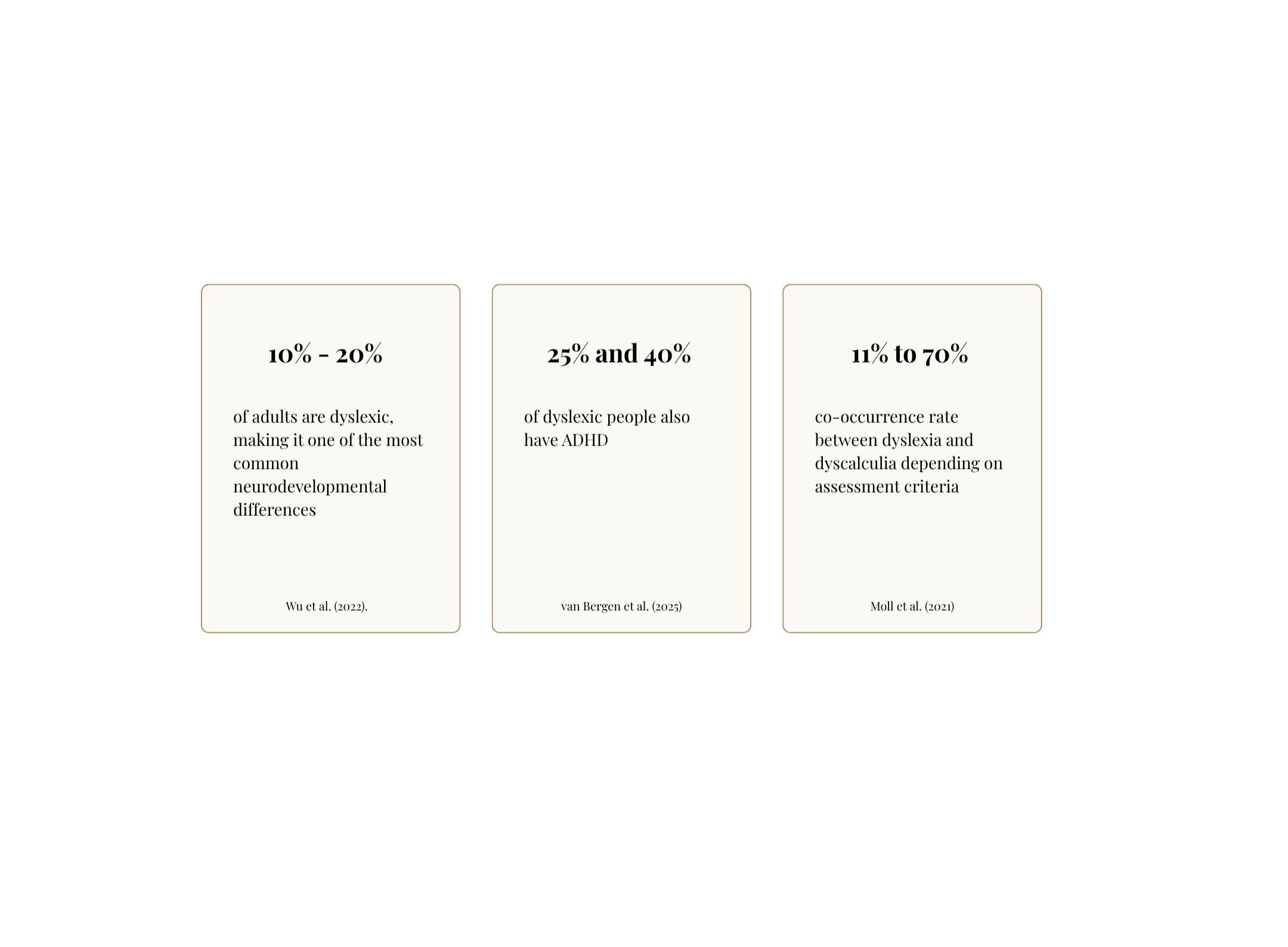
Dyslexia is a common, lifelong neurodevelopmental trait affecting roughly 1 in 10 adults that frequently overlaps with ADHD, autism, and dyscalculia, making each condition harder to recognize in isolation. In October 2025, the International Dyslexia Association updated its definition for the first time since 2002, removing restrictive criteria that had excluded many dyslexic people from support for over two decades. This article explores what dyslexia actually is, key changes in the updated definition, how it presents in adulthood, and its overlap with other neurodivergent conditions.
What Dyslexia Is
Dyslexia is a neurodevelopmental trait characterized by processing differences in accurate word reading, spelling, and phonological mapping, and it is shaped by a combination of genetic, neurobiological, and environmental influences that interact throughout a person's life. The 2025 International Dyslexia Association update made a critical change by removing the requirement that reading difficulties be unexpected relative to general intelligence. This eliminated the outdated IQ-discrepancy model, which previously required reading scores to fall significantly below IQ scores for identification. Decades of research showed this model failed adults across all cognitive profiles, particularly masking those whose high intelligence allowed them to compensate without support. Dyslexia is a lifelong phonological processing difference that affects the mapping between sounds and symbols across all intelligence levels, rather than a visual disorder or a temporary childhood condition.
How Dyslexia shows up in Adults
In adults, dyslexia often involves adaptive reading and writing strategies, with underlying phonological differences becoming visible primarily under time pressure, with unfamiliar vocabulary, or during periods of high cognitive demand.
How dyslexia commonly shows up in adults:
✦ Reading Pace: Reading requires additional processing time while maintaining strong comprehension.
✦ Spelling Styles: Spelling varies within a document, relying on flexible phonetic rules.
✦ Oral Reading: Reading aloud takes more focus than reading silently.
✦ High-Demand Scenarios: Filling out forms, writing under deadlines, or reading publicly requires a lot of mental effort.
✦ Communication Profile: Spoken ideas flow effortlessly, while written expression requires a lot of effort.
✦ Cognitive Energy: Tasks that require literacy draw a lot of mental energy, which can lead to noticeable fatigue.
✦ Parallel Strengths: Advanced verbal memory, visual-spatial thinking, and creative problem-solving coexist with phonological processing traits.
Co-occurring conditions and comorbidity rates
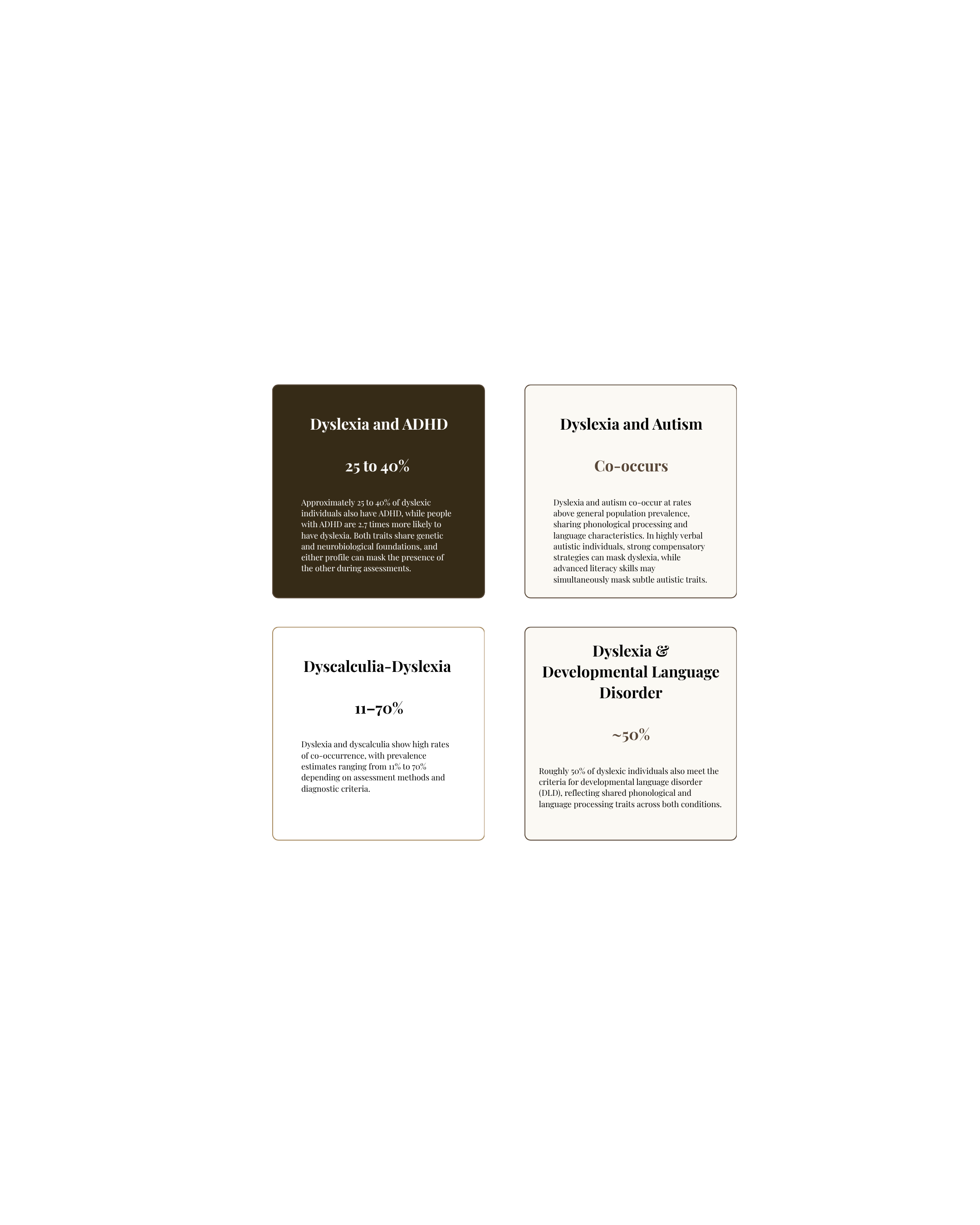
Dyslexia frequently co-occurs with other neurodevelopmental conditions, showing high overlap with ADHD, autism, and dyscalculia.
Why dyslexia goes unidentified in adults
Several factors keep dyslexic traits masked through adulthood. Adaptive strategies built over time, such as but not limited to reading slowly and thoroughly or relying heavily on digital tools, allow an underlying processing profile to remain hidden. In particular, strong verbal reasoning skills can mask dyslexic traits which can conceal the significant cognitive effort required to navigate literacy demands.
Research on diagnostic recognition shows that dyslexia characterizes approximately 1 in 10 adults. Many who grow up without an accurate understanding of their neurotype navigate systemic barriers, social stigma, and the personal cost of moving through life without an affirming framework for their cognitive strengths and processing differences.
For women and girls, this pattern mirrors documented profiles in ADHD and autism, characterized by internalized coping mechanisms and a higher likelihood of processing traits being misclassified as emotional anxiety or insufficient effort. In childhood, dyslexic youth frequently navigate higher rates of social friction and peer pressure, experiences that longitudinally connect to adolescent social dynamics. Without a clear, affirming framework that contextualizes their processing traits and life history, many dyslexic adults navigate these lasting impacts without recognizing how their experiences connect.
What neurodiversity-affirming support for dyslexia looks like
Affirming support views dyslexic processing as a distinct approach to language rather than a deficit, honoring core strengths like visual-spatial reasoning and creative problem-solving while providing practical accommodations where literacy demands create friction.
For adults, effective support pairs environmental adjustments with space to process the psychological impact of navigating unidentified traits, using recent clinical frameworks to emphasize strength-based support structures over rigid performance metrics.
When dyslexia co-occurs alongside ADHD, autism, or dyscalculia, affirming practice addresses the person's complete neurotype as an interconnected whole, rather than isolating individual traits as separate challenges to fix.
References
Moll, K., De Luca, M., Landerl, K., Banfi, C., & Zoccolotti, P. (2021). Editorial: Interpreting the comorbidity of learning disorders. Frontiers in Human Neuroscience, 15, Article e811101. https://doi.org/10.3389/fnhum.2021.811101
van Bergen, E., de Zeeuw, E. L., Hart, S. A., Boomsma, D. I., de Geus, E. J. C., & Kan, K.-J. (2025). *Co-Occurrence and Causality Among ADHD, Dyslexia, and Dyscalculia. Psychological Science, 36(3), 204-217. https://doi.org/10.1177/09567976241293999
Wu, Y., Cheng, Y., Yang, X., Yu, W., & Wan, Y. (2022). Dyslexia: A bibliometric and visualization analysis. Frontiers in Public Health, 10, Article e915053. https://doi.org/10.3389/fpubh.2022.915053