
Neurodivergence and Eating Disorders
This article covers what the research shows about the relationship between neurodivergence and eating disorders, why the connection is so frequently missed.
What the Research Shows
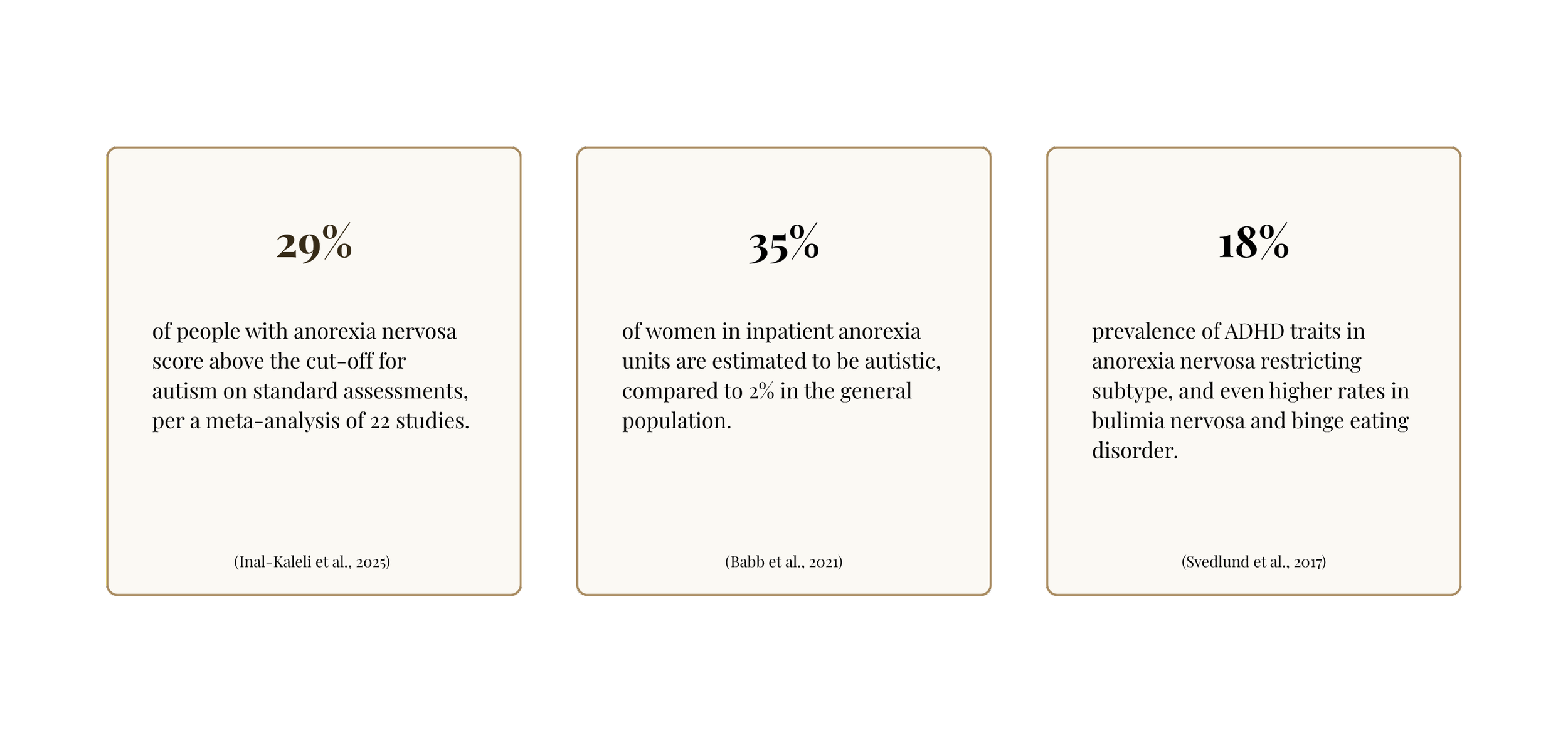
The overlap between neurodivergence and eating disorders isn't a niche finding. A 2024 systematic review and meta-analysis found a significant difference in autistic traits between people with anorexia nervosa and healthy controls, with 29% of anorexia nervosa patients scoring above the cut-off for autism on assessments, suggesting that unidentified autism is a genuinely significant factor in a substantial portion of anorexia presentations. Yet, routine autism screening in eating disorder services has historically been rare. This pattern is consistent across all three eating disorder presentations, though it manifests differently depending on the condition and the specific neurodivergent identity.
Anorexia Nervosa and Autism
As autistic people experience the highest rate of co-occurrence with anorexia nervosa compared to non-autistic individuals, shared cognitive traits (Kirkovski et al., 2025), such as cognitive rigidity, attention to detail, strict rule-following, and interoceptive differences, can cause restrictive eating to become deeply entrenched.
Bulimia Nervosa, Binge Eating, and ADHD
ADHDers experience bulimia nervosa and binge eating disorder at the highest rates, with research consistently connecting impulsivity and emotional dysregulation to bingeing and purging behaviors (El Archi et al., 2020). Impulsivity and inattention are shared characteristics of both bulimia nervosa and ADHD, with ADHD occurring more frequently in people with bulimia nervosa than in the general population. This connection reflects a direct alignment where challenges with impulse regulation, emotional dysregulation, and the dopamine-seeking nature of bingeing map directly onto how an ADHD brain operates under stress.
Why the Connection Is Overlooked
Several factors intersect to keep neurodivergence and eating disorders from being identified simultaneously in the same individual. Eating disorder services have historically not screened for autism or ADHD, and many clinicians trained in eating disorder settings lack training in neurodivergent presentations.
For autistic females, who experience higher rates of depression, anxiety, suicidality, and eating disorders than autistic males, especially during adolescence, restrictive eating often serves as a coping mechanism for sensory overload and social unpredictability (Babb et al., 2021). Recognizing restrictive eating as a nervous system regulation and coping strategy, rather than an inherent pathology, can change how care should be delivered.
For ADHDers, internalizing or hiding neurodivergent traits shows up differently, but the resulting invisibility is the same. When bingeing and purging are driven by impulsivity and emotional dysregulation, they can easily be mistaken for an eating disorder if the ADHD is overlooked (Makin et al., 2026).
Understanding how neurodivergence and eating disorders overlap is essential to providing effective care.
References
Babb, C., Brede, J., Jones, C. R. G., Elliott, M., Zanker, C., Tchanturia, K., Serpell, L., Mandy, W., & Fox, J. R. E. (2021). 'It's not that they don't want to access the support . . . it's the impact of the autism': The experience of eating disorder services from the perspective of autistic women, parents and healthcare professionals. Autism,25(5), 1409–1421. https://doi.org/10.1177/1362361321991257
El Archi, S., Cortese, S., Ballon, N., Réveillère, C., De Luca, A., Barrault, S., & Brunault, P. (2020). Negative affectivity and emotion dysregulation as mediators between ADHD and disordered eating: A systematic review. Nutrients, 12(11), Article e3292. https://doi.org/10.3390/nu12113292
Inal-Kaleli, I., Dogan, N., Kose, S., & Bora, E. (2025). Investigating the presence of autistic traits and prevalence of autism spectrum disorder symptoms in anorexia nervosa: A systematic review and meta-analysis. The International Journal of Eating Disorders, 58(1), 66–90. https://doi.org/10.1002/eat.24307
Kirkovski, M., Papavasiliou, G., Speranza, B. E., Scarfo, J., Albein-Urios, N., Linardon, J., Phillipou, A., Fuller-Tyszkiewicz, M., & Enticott, P. G. (2025). Autism spectrum disorder and anorexia nervosa: Investigating the behavioural and neurocognitive overlap. Psychiatry research, 344, Article e116285. https://doi.org/10.1016/j.psychres.2024.116285
Makin, L., Allen, K., & Tchanturia, K. (2026). Time to notice neurodiversity in eating disorder services: a three-year real-world analysis of autism, ADHD, and AuDHD. Frontiers in Psychiatry, 17, Article e1787957. https://doi.org/10.3389/fpsyt.2026.1787957