

The Similarities and Difference Between ADHD and BPD, and Why Misdiagnosis Is Common
ADHD and borderline personality disorder share enough on the surface that getting them confused is a well-documented clinical problem. This article covers what each condition is, where they differ, where they overlap, how often they co-occur, and implications of misdiagnosis.
What Attention Deficit Hyperactivity Disorder is
Attention Deficit Hyperactivity Disorder (ADHD) is a neurodevelopmental condition involving inattention and/or hyperactivity and impulsivity that impacts a person’s functioning and ability to perform daily activities, including at school and work. Emotional dysregulation is a widely recognized and core feature of ADHD, but it’s not officially listed in the Diagnostic and Statistical Manual of Mental Disorders (DSM-5) diagnostic criteria. Research consistently demosntrates that 34–70% of ADHD adults experience difficulties in emotion dysregulation (Gomez et al., 2026). The emotional response is real and often intense, but it's typically triggered by specific situations, particularly perceived failure, criticism, or rejection, rather than a pervasive instability in self-image or identity.
What Borderline Personality Disorder is
Borderline personality disorder (BPD) is a personality disorder characterized by a pervasive pattern of instability in interpersonal relationships, self-image, and affect, along with marked impulsivity. The DSM-5 requires five or more of nine criteria for diagnosis, including frantic efforts to avoid real or imagined abandonment, unstable and intense interpersonal relationships, identity disturbance, impulsivity, recurrent suicidal behaviour or self-harm, affective instability, chronic feelings of emptiness, inappropriate or intense anger, and transient stress-related paranoid ideation or dissociation.
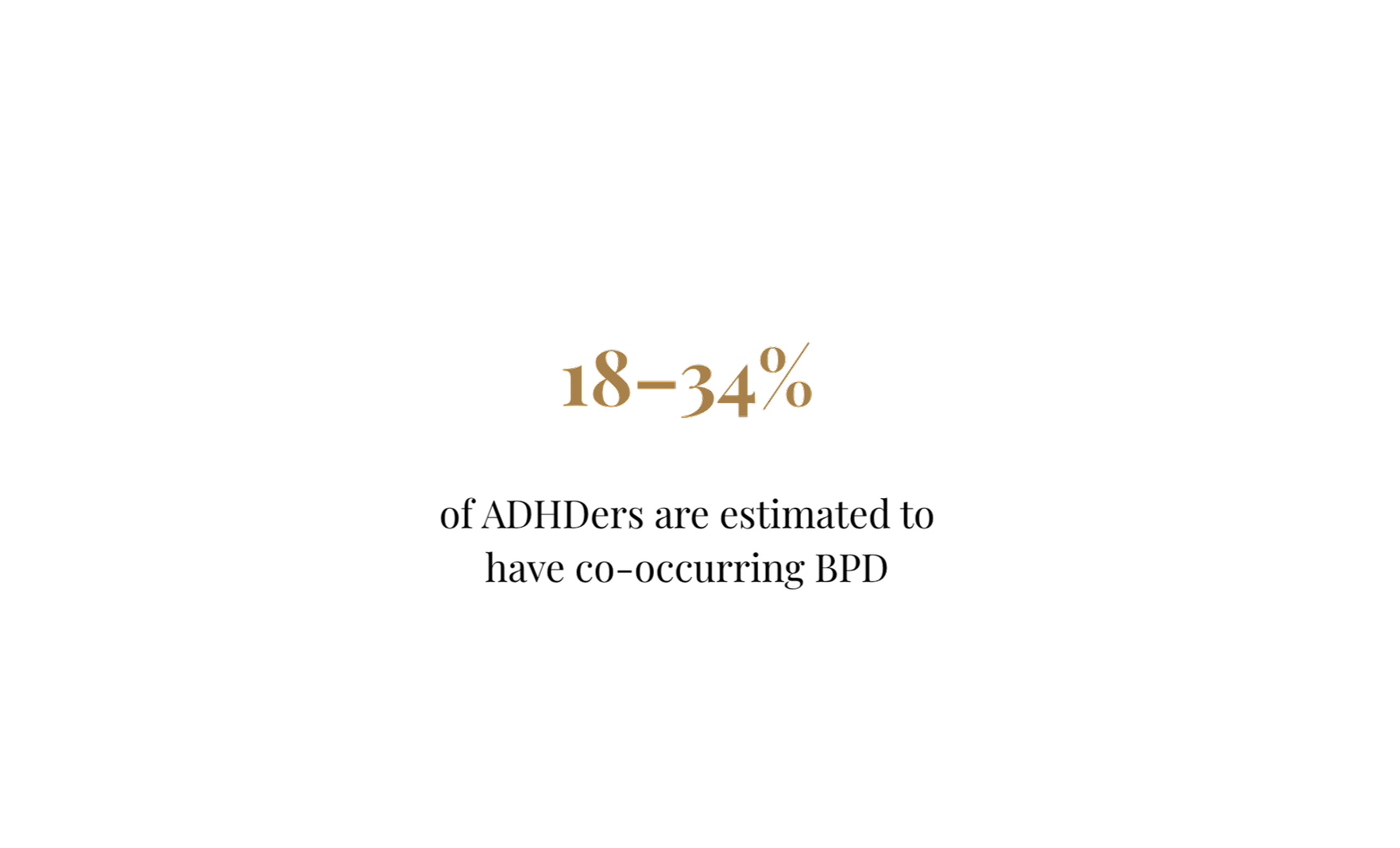
BPD is typically diagnosed in adulthood and has a strong association with childhood trauma, particularly relational trauma and adverse experiences in early attachment relationships. Research from 2025 places co-occurrence rates between ADHD and BPD at 18% to 34% in adults, with both conditions sharing developmental and environmental risk factors (Barata & Gonçalves, 2025).
Where they look alike
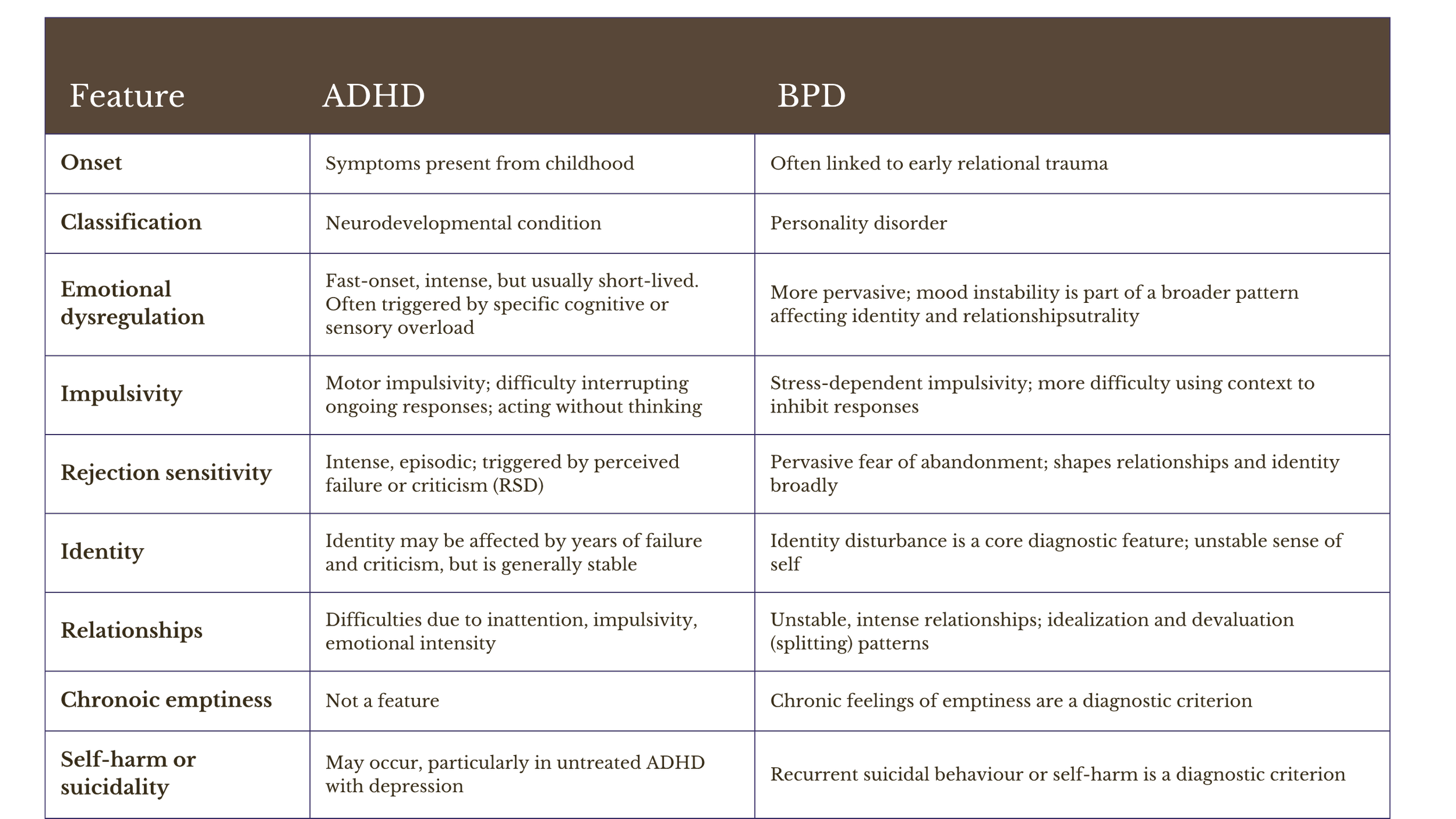
At a glance, ADHD and BPD look similar because they share several core traits.
Why misdiagnosis happens and who it affects most
The misdiagnosis of ADHD as BPD, especially in ADHD women, is a well-documented issue in research. requently misdiagnose ADHD individuals due to male-centric diagnostic bias, superficial behavioral overlap, masking, and incomplete developmental histories.
Diagnostic Tool and Gender Bias
Diagnostic criteria for ADHD were historically developed using non-masking, hyperactive young males as the baseline model (Hinshaw et al., 2021). Because ADHD girls and women more frequently present with internal restlessness, chronic disorganization, and internalizing distress rather than overt physical disruption, their neurodivergence is easily missed in childhood. When adult ADHD women eventually seek mental health support for chronic overwhelm, clinicians unfamiliar with female ADHD presentations often default to personality disorder labels like BPD (Attoe & Climie, 2023).
High-Level Masking and Neurodivergent Burnout
Many unidentified ADHD adults spend years engaging in high-level social camouflaging, expending constant cognitive energy to compensate for executive dysfunction and pass as neurotypical. When individuals eventually seek clinical care in a state of severe nervous system exhaustion, providers often observe only the acute emotional crisis and mischaracterize it as BPD personality instability (Weiner et al., 2019).
Diagnostic Co-Occurrence and Systemic Trauma
Beyond misdiagnosis, high rates of diagnostic comorbidity exist between these experiences. Population registry data reveals that 29.6% of females diagnosed with BPD are also ADHD individuals, representing a 19.4-fold increase in odds compared to non-ADHD controls (Kuja-Halkola et al., 2021). Furthermore, growing up as an unidentified neurodivergent person in a neurotypical world routinely exposes individuals to chronic invalidation, academic trauma, and social rejection. Over time, this environment can create secondary interpersonal trauma that mimics or actively exacerbates personality dysregulation (Young et al., 2020).
When both are present
Co-occurrence is common and well-documented, with research demonstrating that 33.7% of ADHDers have a co-occurring diagnosis of BPD, compared to 5.2% in the general population (Kessler et al., 2006). When an individual holds both identities, core traits, particularly emotional intensity and impulsivity, can feel exponentially heightened (Weiner et al., 2019). Consequently, effective support requires a holistic approach rather than isolating one experience over the other. Dialectical Behaviour Therapy (DBT), while originally developed for BPD provides tools for ADHDers by supporting emotional regulation and interpersonal navigation (Zhang et al., 2025).
What accurate diagnosis changes
Receiving an accurate ADHD identification changes how someone understands their own history, what support they seek, and what they believe is possible going forward. For an ADHDer who's spent years in misdiagnosis, it can provide an explanation for lifelong executive function differences and chronic burnout, and while it can't undo the exhaustion of navigating a neurotypical world, it may open access to tailored strategies, accommodations, and a far more compassionate relationship with themselves.
References
Attoe, D. E., & Climie, E. A. (2023). Miss. diagnosis: A systematic review of ADHD in adult women. Journal of Attention Disorders, 27(7), 645–657. https://doi.org/10.1177/10870547231161533
Barata, V. A., & Gonçalves, P. (2025). Unraveling the link between borderline personality disorder and attention deficit hyperactivity disorder. European Psychiatry, 68(S1), S95-S95. https://doi.org/10.1192/j.eurpsy.2025.293
Gomez, R., Brown, T., Zarate, D., Houghton, S., & Stavropoulos, V. (2026). A network approach to the association between emotional regulation and ADHD symptoms in adults: Pathways between difficulties in emotional regulation and ADHD dimensions. Psychiatric Quarterly, 97(2), 231-251. https://doi.org/10.1007/s11126-026-10270-x
Kessler, R. C., Adler, L., Barkley, R., Biederman, J., Conners, C. K., Demler, O., Faraone, S. V., Greenhill, L. L., Howes, M. J., Secnik, K., Spencer, T., Stein, M. A., Ueda, J. J., & Zaslavsky, A. M. (2006). The prevalence and correlates of adult ADHD in the United States: Results from the national comorbidity survey replication. The American Journal of Psychiatry, 163(4), 716–723. https://doi.org/10.1176/ajp.2006.163.4.716
Kuja-Halkola, R., Lind Juto, K., Skoglund, C., Rück, C., Mataix-Cols, D., Pérez-Vigil, A., Larsson, J., Hellner, C., Långström, N., Petrovic, P., Lichtenstein, P., & Larsson, H. (2021). Do borderline personality disorder and attention-deficit/hyperactivity disorder co-aggregate in families? A population-based study of 2 million Swedes. Molecular Psychiatry, 26(1), 341–349. https://doi.org/10.1038/s41380-018-0248-5
Hinshaw, S. P., Nguyen, P. T., O’Grady, S. M., & Rosenthal, E. A. (2021). Annual research review: Attention-deficit/hyperactivity disorder in girls and women: Underrepresentation, longitudinal outcomes, and modern perspectives. Journal of Child Psychology and Psychiatry, 63(4), 484–496. https://doi.org/10.1111/jcpp.13480
Weiner, L., Perroud, N., & Weibel, S. (2019). Attention deficit hyperactivity disorder and borderline personality disorder in adults: A review of their links and risks. Neuropsychiatric Disease and Treatment, 15, 3115–3129. https://doi.org/10.2147/NDT.S192871
Young, S., Adamo, N., Ásgeirsdóttir, B. B., Branney, P., Beckett, M., Colley, W., Cubbin, S., Deeley, Q., Farrag, E., Gudjonsson, G., Hill, P., Hollingdale, J., Kilic, O., Lloyd, T., Mason, P., Paliokosta, E., Perecherla, S., Sedgwick, J., Skirrow, C., Tierney, K., … Woodhouse, E. (2020). Females with ADHD: An expert consensus statement taking a lifespan approach providing guidance for the identification and treatment of attention-deficit/ hyperactivity disorder in girls and women. BMC Psychiatry, 20(1), 404. https://doi.org/10.1186/s12888-020-02707-9
Zhang, Z., Gu, W., Wei, Y., Wu, S., & Wang, C. (2025). Dialectical behavioral therapy for adult attention deficit/hyperactivity disorder: A meta-analysis of randomized controlled trials. Psychiatry Research, 351, Article e116551. https://doi.org/10.1016/j.psychres.2025.116551